TRANCEcolonial - An Intervention in the Collection of the LWL-Museum für Kunst und Kultur
TRANCEcolonial
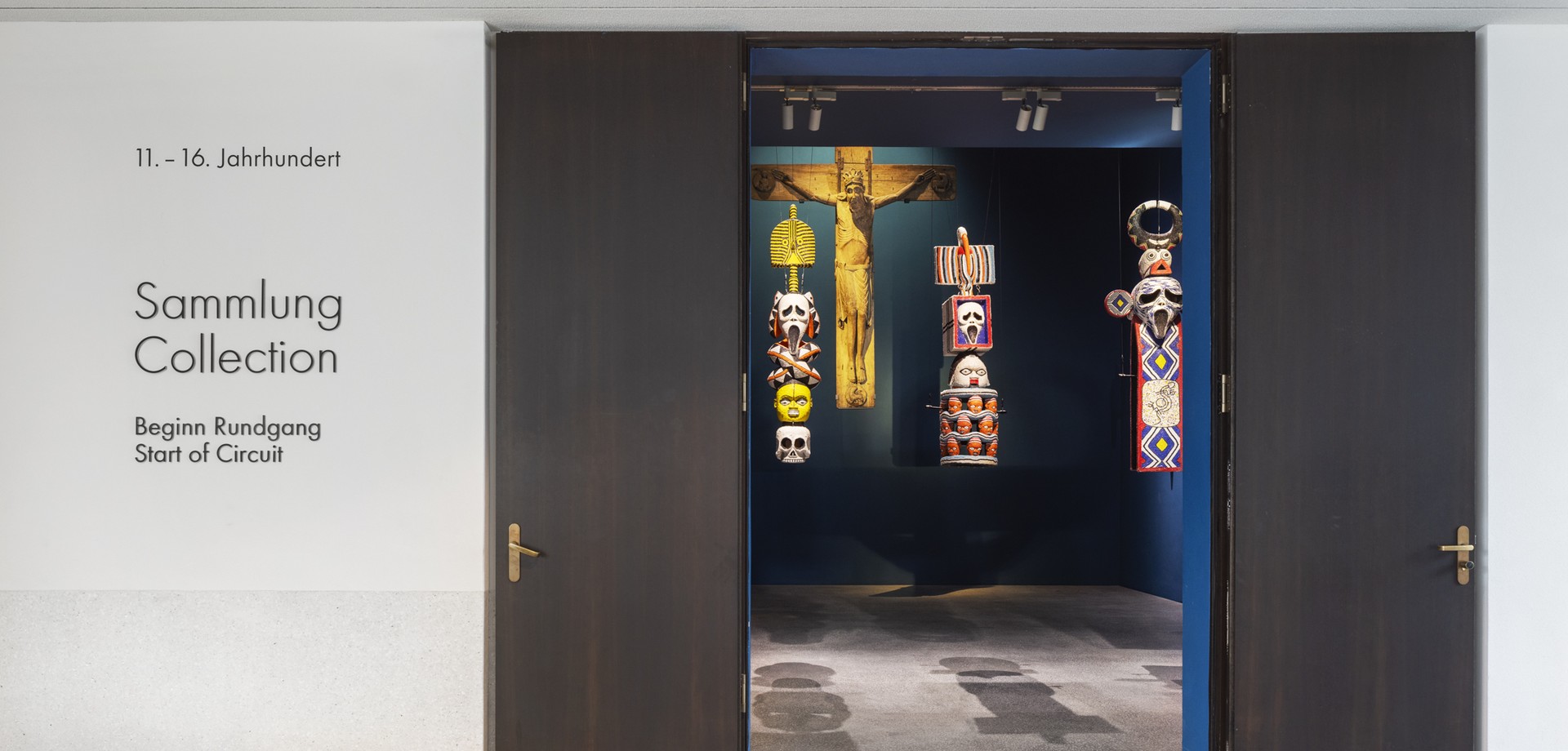
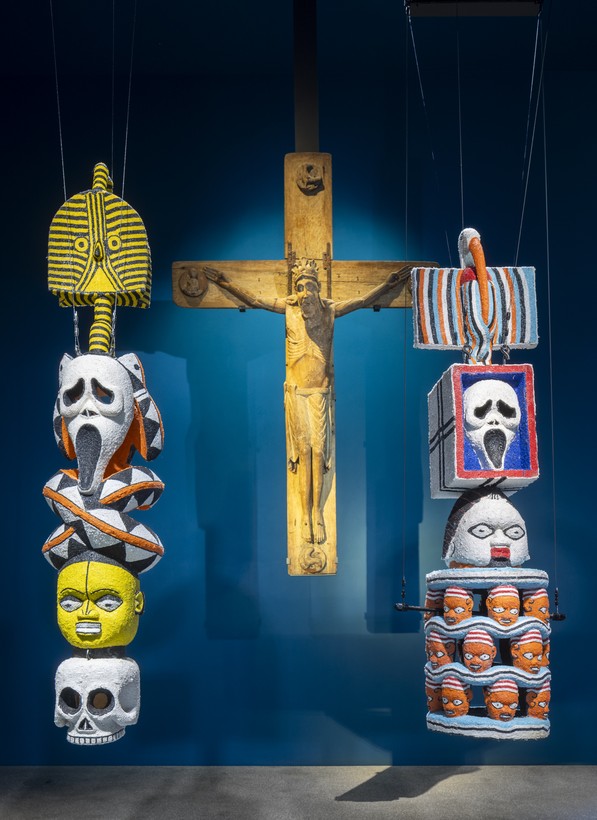
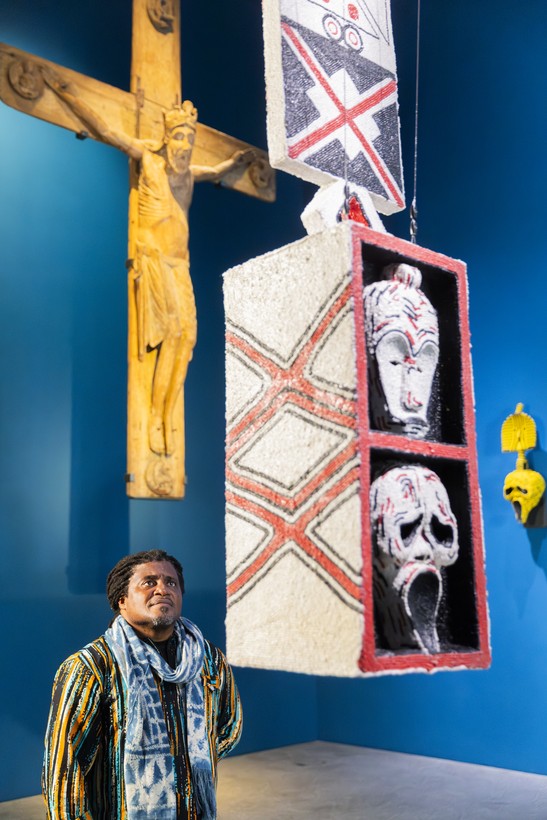
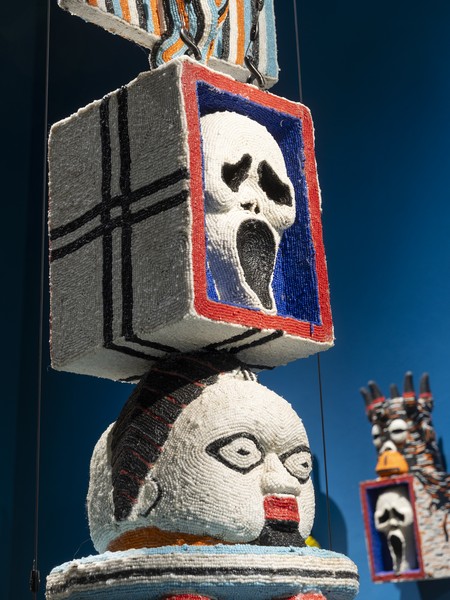
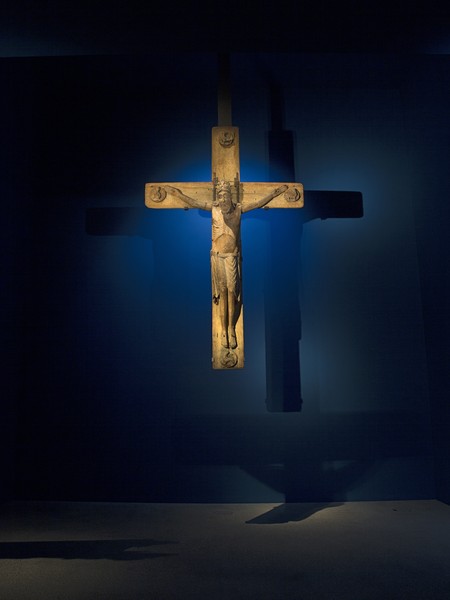
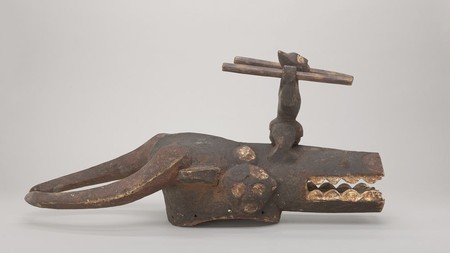
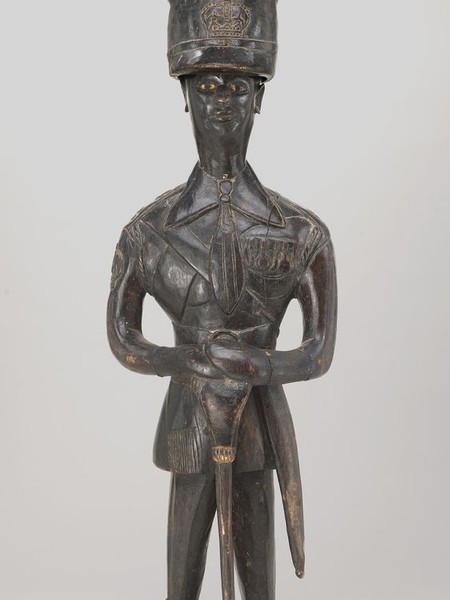
In the first room of the museum tour, works of art from different periods and cultural contexts come together. The medieval Bockhorst Triumph Cross enters into a dialogue with the installation ‘Les masques célèstes’ by the Cameroonian artist Hervé Youmbi, which was created in 2017 for the Skulptur Projekte Münster and is now being presented inside the museum for the first time. This encounter is borne out by two objects from the ‘Forum der Völker’ collection on missionary history in Werl. At first glance, there appears to be little connecting the works. Yet it is precisely their joint presentation that raises new questions about cultural and religious concepts, and their similarities and differences.
This dialogue, however, does not arise solely from the juxtaposition of the works. It can only unfold when we, as viewers, approach them, relate them to one another and interpret them through the lens of our own experiences. What we perceive in the process also depends on the knowledge we bring with us and the ideas that shape our perspective. At the same time, through its selection and arrangement of the objects, the museum determines which encounters are even possible. Thus, our attention is directed not only towards the works themselves, but also towards the museum’s narrative perspective and the question of how it influences our understanding of history.
More Information
A matter of perspective
At first glance, the medieval Bockhorst Triumph Cross (late 12th century) and Hervé Youmbi’s installation ‘Les masques célèstes’ (2017) appear to have little in common. They originate from different eras and cultural contexts, yet both address fundamental questions concerning lived faith. What significance do objects hold within ceremonial practices? How can they give visible form to ideas and beliefs and establish a connection between humankind and the supernatural or spiritual?
Whilst the Triumph Cross is rooted in the Christian faith and its liturgical practice, Youmbi draws on various religious and cultural traditions with his masks, placing them within a contemporary artistic context. What unites both works is the idea that religious objects can be far more than mere representations: their significance also arises from the actions, ideas and experiences of the people who engage with them.
The joint exhibition brings these connections to light without obscuring the differences between the works and their respective contexts of origin. It invites viewers not only to perceive the supposedly unknown in terms of its foreignness, but also to recognise the common ground within what appears to be different.
The ‘PERFORM’ research project
The impetus for this intervention came from the international research project ‘Performing Provenance: Contemporary Art, Digital Spaces, and Things from the Cameroon Grassfields (PERFORM)’. It brings together researchers, artists and cultural institutions from Germany, France and Cameroon and examines the colonial history of museum collections, their provenance and the consequences of colonial violence that continue to be felt today. Artistic research opens up new ways of engaging with the objects, their stories and the experiences associated with them.
This is where the intervention ‘TRANCEcolonial’ comes in; its title is derived from the performance artist Zora Snake. By drawing on the concept of trance, the intervention highlights, amongst other things, how the boundaries between consciousness and the unconscious, self-determination and loss of control become blurred. In the context of colonialism, it refers to experiences of external control and powerlessness, the consequences of which extend far beyond the historical ruptures of colonialism. At the same time, the intervention explores how familiar ways of thinking and traditional notions can be challenged, and what other perspectives this might open up.
The PERFORM project is made possible by the Franco-German Provenance Research Fund for Cultural Artefacts from Sub-Saharan Africa, based at the Centre Marc Bloch. It is funded by the Federal Government Commissioner for Culture and the Media and the French Ministry of Culture. Further thanks go to the Federal Ministry of Research, Technology and Space (BMFTR) and the French Ministry for Europe and Foreign Affairs (MEAE).
Further information on the project and the participating institutions can be found here.
Objects
Kick-off
Artist talk with Hervé Youmbi
Monday, 9.11.2026
7 – 8.30 p.m.
To mark the start of the event on Monday evening (9 November) at 7 pm, the artist Youmbi will be a guest at the museum to talk about his work and artistic practice. This will be followed by a discussion about the project with Dr Marianne Wagner, curator of contemporary art, and Dr Petra Marx, curator of medieval art. Admission is free; no booking is required.
Programme:
Welcome
Dr. Hermann Arnhold, Director of the LWL Museum of Art and Culture
Artist talk
Hervé Youmbi, artist
Dr. Petra Marx, curator of medieval art
Dr. Marianne Wagner, curator of contemporary art
Symposium
TRANCEcolonial
Performing Provenance – Art, Memory and Colonial Resonances
10. November 2026
LWL-Museum für Kunst und Kultur, Münster, Auditorium
The one-day symposium TRANCEcolonial. Performing Provenance – Art, Memory and Colonial Resonances explores colonial provenance, historical experiences of violence and museums’ responsibilities today from artistic, scholarly and museological perspectives. On the occasion of the symposium, the LWL-Museum für Kunst und Kultur in Münster[PUF1] will bring a work by Hervé Youmbi, an artist from Cameroon, into dialogue with objects from its collection. The event in Münster opens a series of events initiated as part of the international research project Performing Provenance: Contemporary Art, Digital Spaces, and Things from the Cameroon Grassfields (PERFORM). Further events will take place as part of the exhibition return at the Rautenstrauch-Joest-Museum in Cologne on November 12-13th 2026.
The symposium will be held in English and French. Interpretation will be provided from French into English and from English into French. Handouts in German will also be provided.
Organised jointly by the LWL-Museum für Kunst und Kultur and the Centre for Advanced Study “Access to Cultural Goods in Digital Change” at the University of Münster as part of the international research project PERFORM.
We are especially grateful to the Centre Marc Bloch Berlin for granting generous support through the Franco-German Research Fund for the Provenance of Cultural Objects from Sub-Saharan Africa.
Tours
Every third Wednesday of the month, 60 minutes each
16 December, 4.30 pm
Kiana Tellen, research assistant for contemporary art
20 January, 4.30 pm
Dr. Petra Marx, curator of medieval art
17 February, 4.30 pm
Dr. Marianne Wagner, Curator of Contemporary Art
17 March, 4.30 pm
Dr. Marianne Wagner, Curator of Contemporary Art
21 April, 4.30 pm
Nora Staege, Digital Communications Officer
19 May, 4.30 pm
Nora Staege, Digital Communications Officer